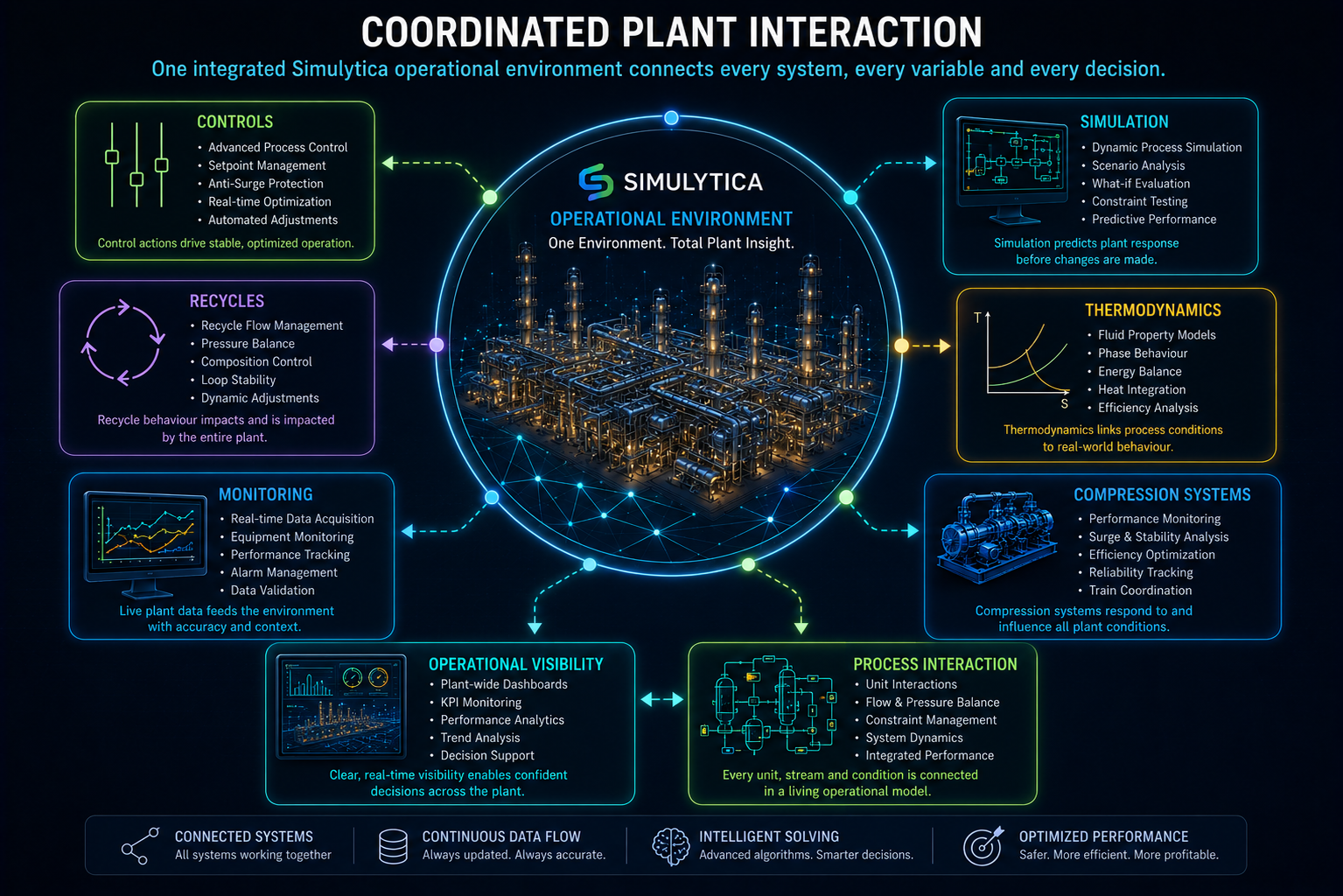
Every Connection Carries Distinct Engineering Behaviour
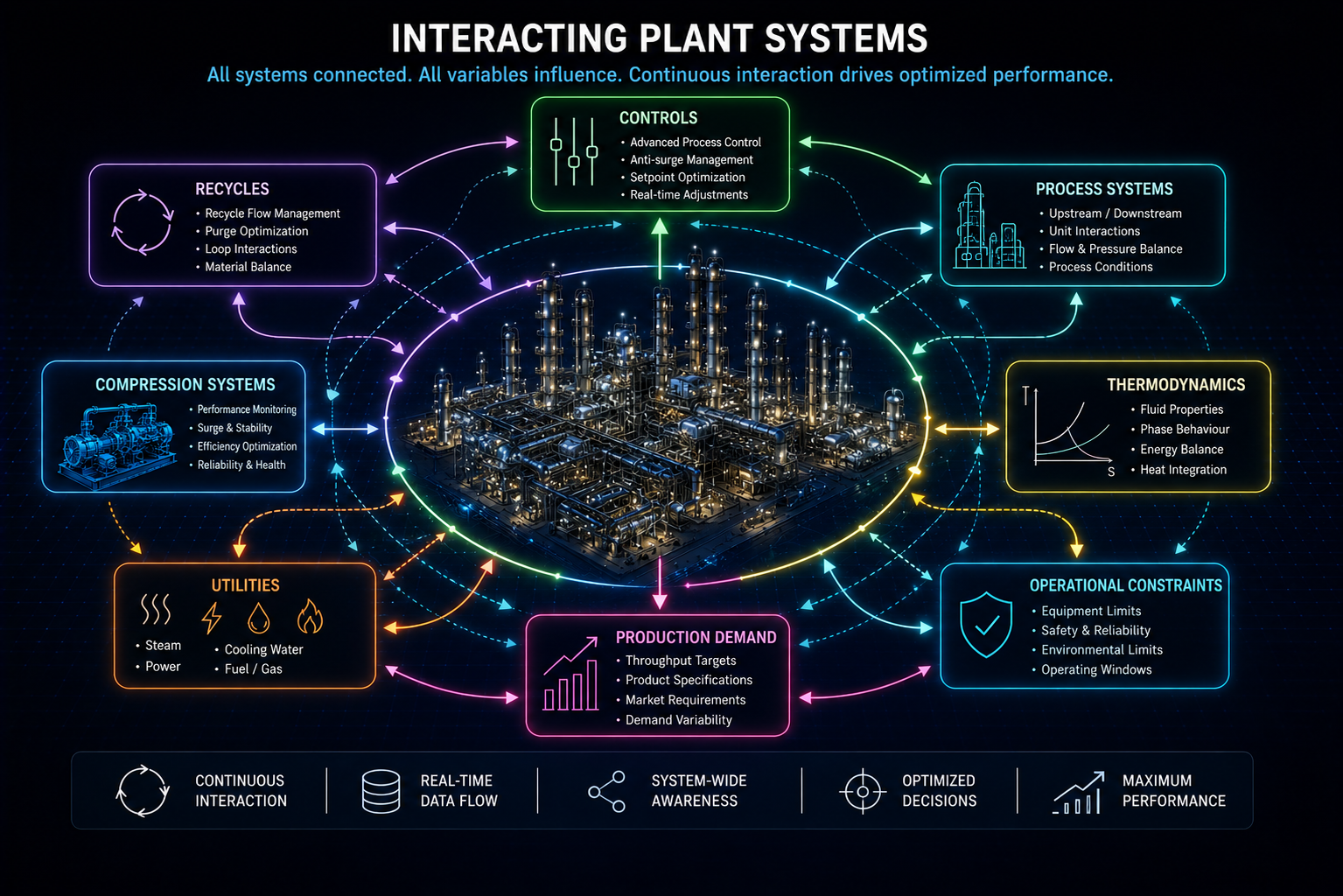
A plant is not simply a network of connected equipment. Process streams transfer material and energy, control connections transmit control response, mechanical connections transfer power and electrical connections define equipment availability and demand.
Simulytica preserves every connection as an executable engineering relationship throughout the plant calculation. Controls, equipment and recycles retain their distinct behaviour while interacting across the facility, enabling complex plant systems to be represented and solved without reducing their connections to generic mathematical relationships.
Plant connectivity must preserve engineering behaviour, not simply structure.
Solving Plant and Control Response Together
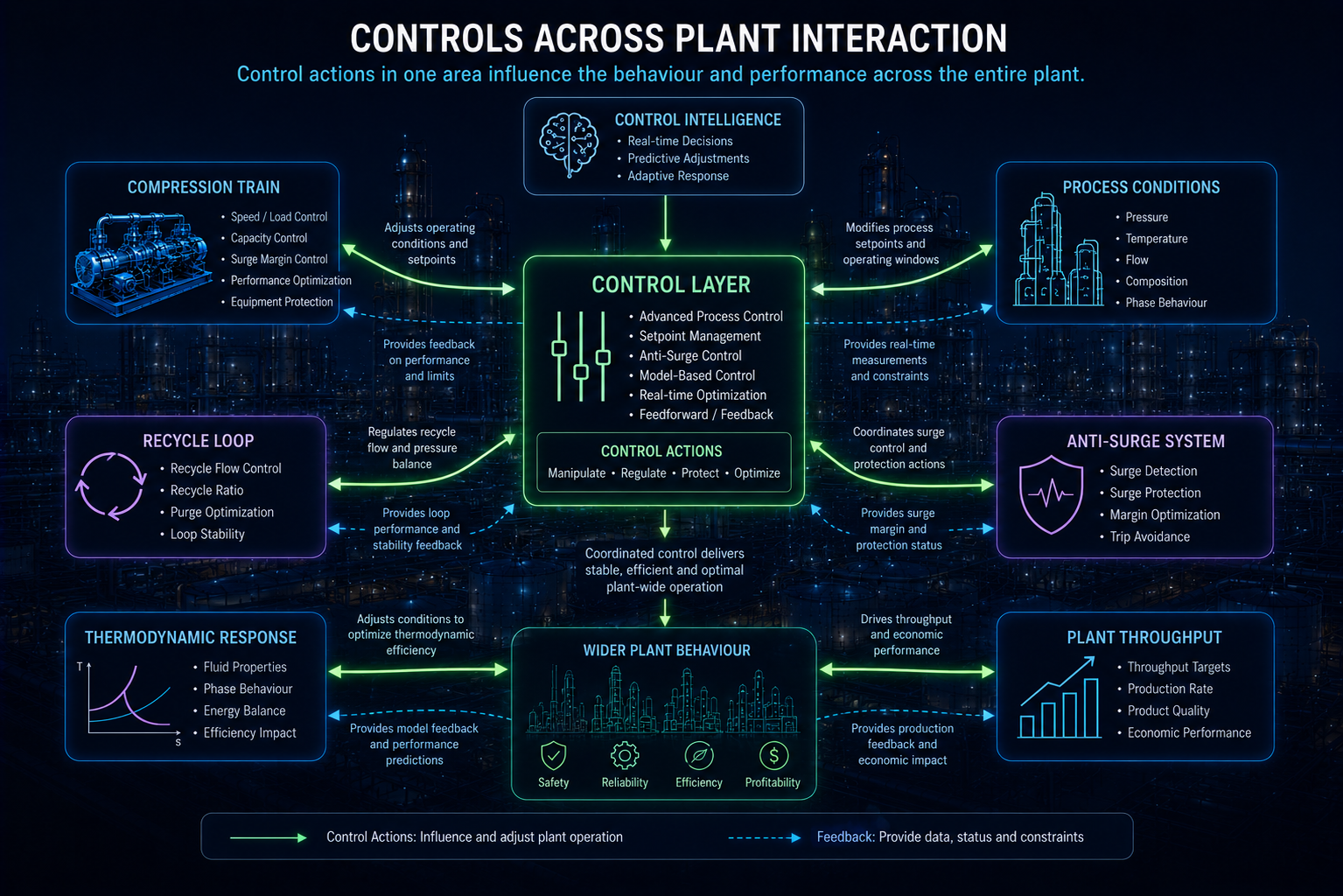
Control actions alter valves, equipment operation, process conditions and recycle flow, producing responses that propagate through connected plant systems. The resulting process changes then affect subsequent control response, creating interactions that must be resolved together.
Simulytica calculates control behaviour within the plant engineering system, coordinating multiple control systems with equipment and process response. Setpoints, constraints and control actions remain connected to the plant conditions they influence, allowing the complete interaction to converge automatically.
Controls do not sit outside plant behaviour. They actively determine it.
Intelligent Convergence of Interacting Recycles
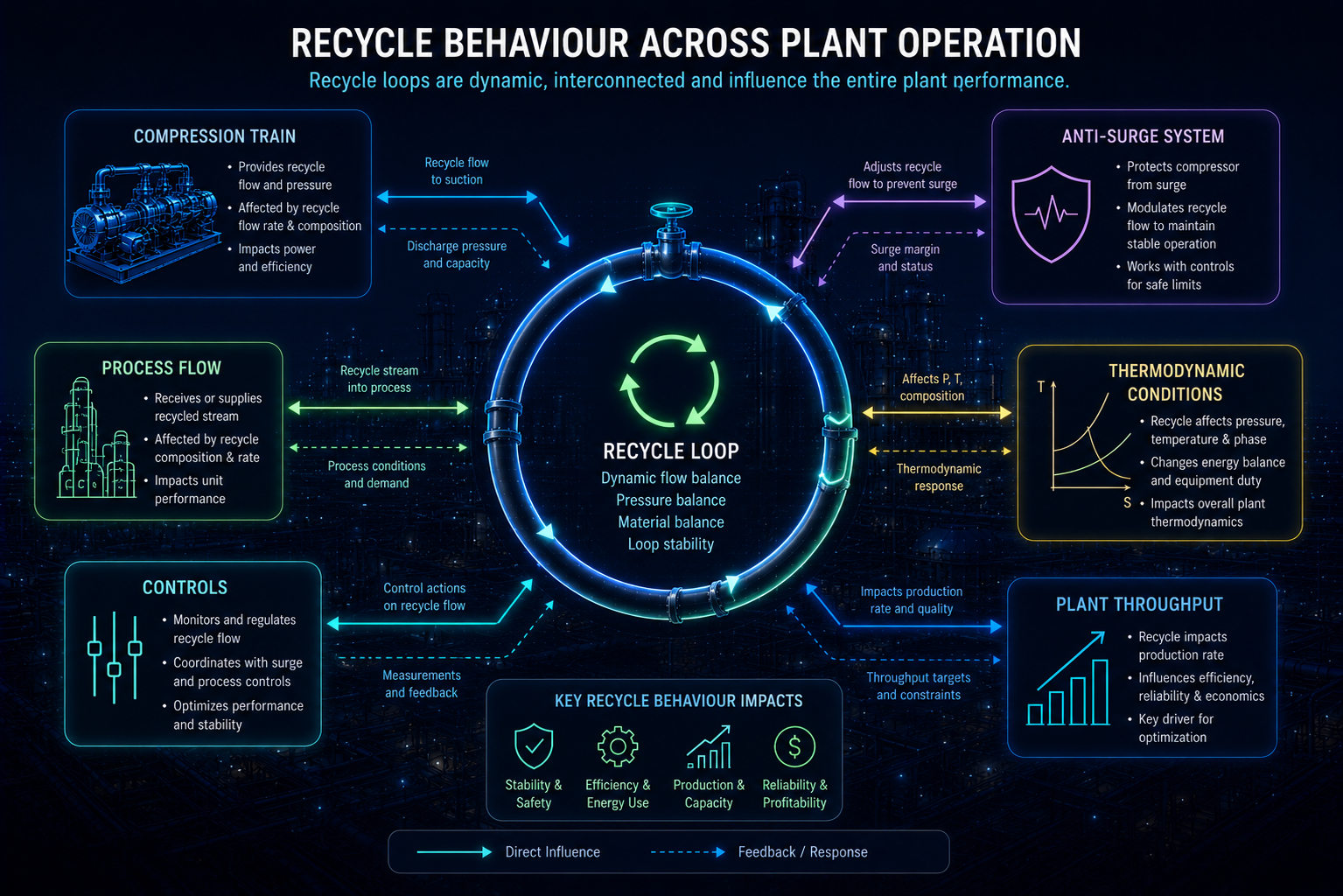
LNG refrigeration systems, compression systems and complex process arrangements can contain multiple nested recycles. Changes within one recycle alter the conditions entering others, creating coupled interactions that are difficult to stabilise and converge as isolated loops.
Simulytica preserves the engineering structure of every recycle and its relationship with connected equipment, controls and process conditions. Intelligent adaptive solvers use this representation to resolve the combined system and converge nested recycle behaviour automatically.
Accurate representation makes intelligent recycle convergence possible.
Automatically Solving Complex Plant Interactions
Control systems, equipment calculations and nested recycles create different convergence requirements throughout a facility. Their interactions must be resolved without losing the engineering relationships that connect them.
Simulytica analyses the plant engineering structure and intelligently applies physics-based adaptive solvers to complex interactions. Scalable, parallel execution supports independent thermodynamic and engineering calculations while the connected system converges automatically.
Intelligent solvers adapt to the engineering structure of the plant.
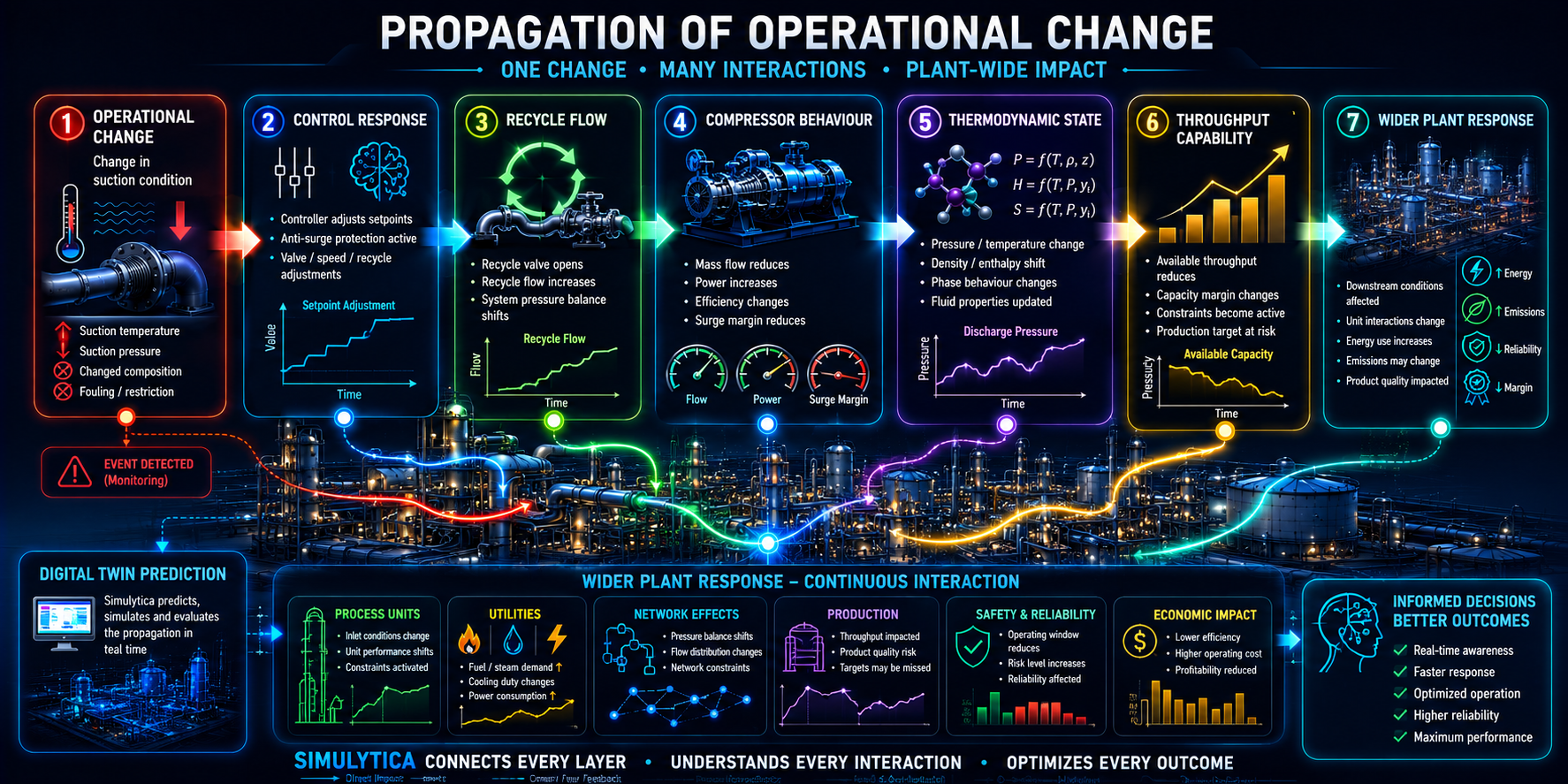
Determine How Controls and Recycles Affect Performance
Control response and recycle operation can change equipment efficiency, energy consumption, operating limits, throughput and production across compression systems, LNG refrigeration and process facilities.
Simulytica calculates these effects within the connected plant system. Operators gain insight into the interactions affecting current performance and constraints, while engineers can investigate control behaviour, assess recycle operation and evaluate alternative strategies before applying changes to the plant.
This allows engineering and operational teams to better evaluate:
- Plant behaviour
- Machinery response
- Control interaction
- Recycle behaviour
- Thermodynamic response
- Operational efficiency
- Production capability
- Wider operational constraints
Understanding controls and recycles in this way supports a broader and more realistic view of how industrial facilities actually behave across changing operating conditions
Understand the interaction. Determine the impact. Evaluate the alternative.