
Valuable Capabilities Developed in Isolation
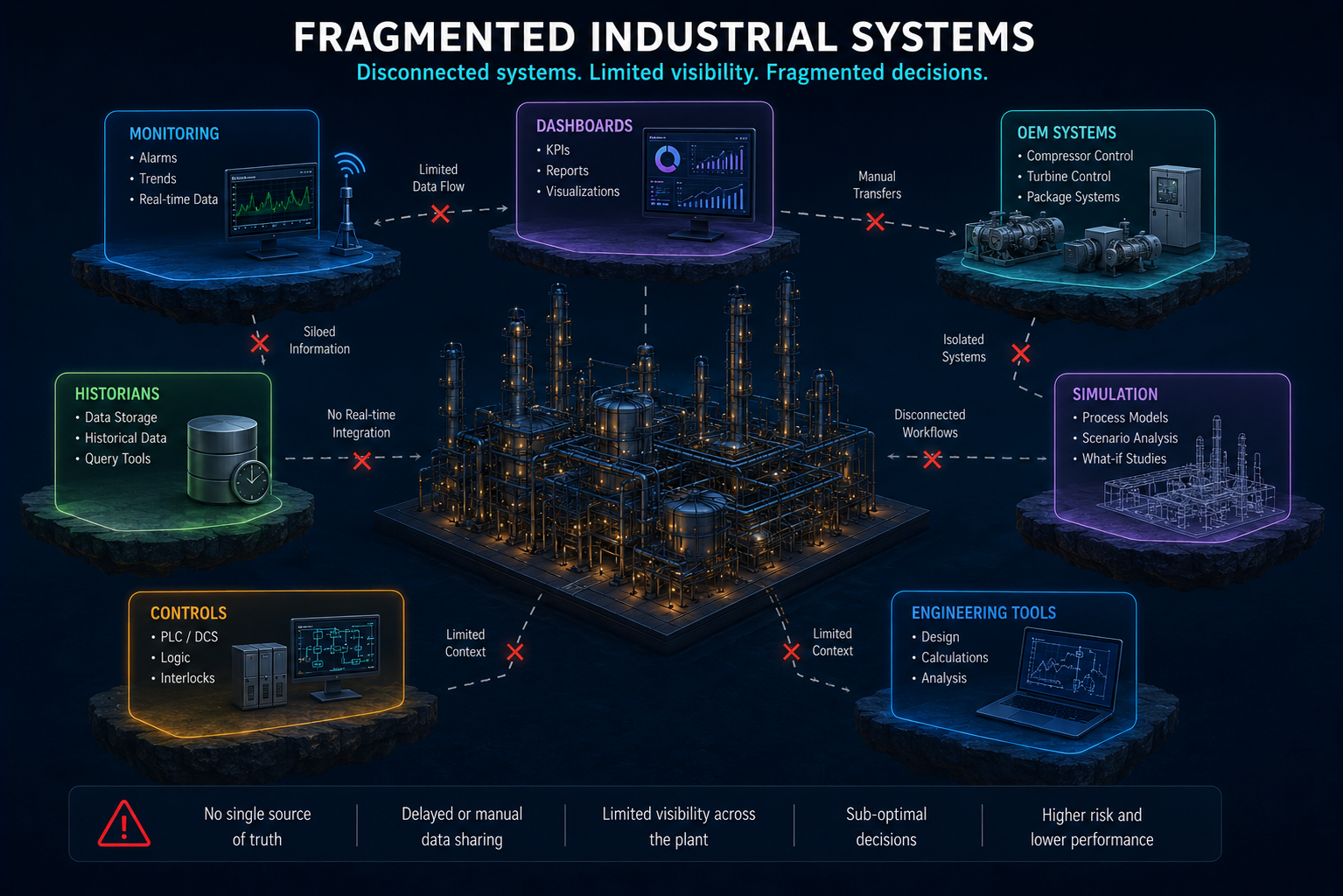
Industrial software has evolved around distinct requirements. Simulation supports design and engineering analysis; monitoring evaluates operating conditions; historians retain plant data; OEM applications provide machinery-specific capability; and control systems manage plant response.
Each discipline provides essential value. Fragmentation arises when these technologies retain separate models, calculations and operating contexts, requiring the wider engineering picture to be assembled across application boundaries.
As facilities and engineering requirements become more complex, maintaining that wider context through separate systems becomes increasingly difficult.
Specialist capability loses wider context when it remains isolated.
Reconstructing Engineering Context Across Systems
Connecting separate applications requires more than transferring plant data. Calculated state, model assumptions, equipment definitions and operating context must remain consistent as information moves between systems developed for different purposes.
Interfaces must be maintained as software, models and plant requirements change. Synchronisation, update anomalies and different execution rates add continuing technical complexity, while expanding or redeploying the capability may require changes across several applications.
The integration layer therefore becomes responsible for reconstructing engineering context that no individual system maintains completely.
Exchanging information does not guarantee a consistent engineering state.
Plant Behaviour Crosses Software Boundaries
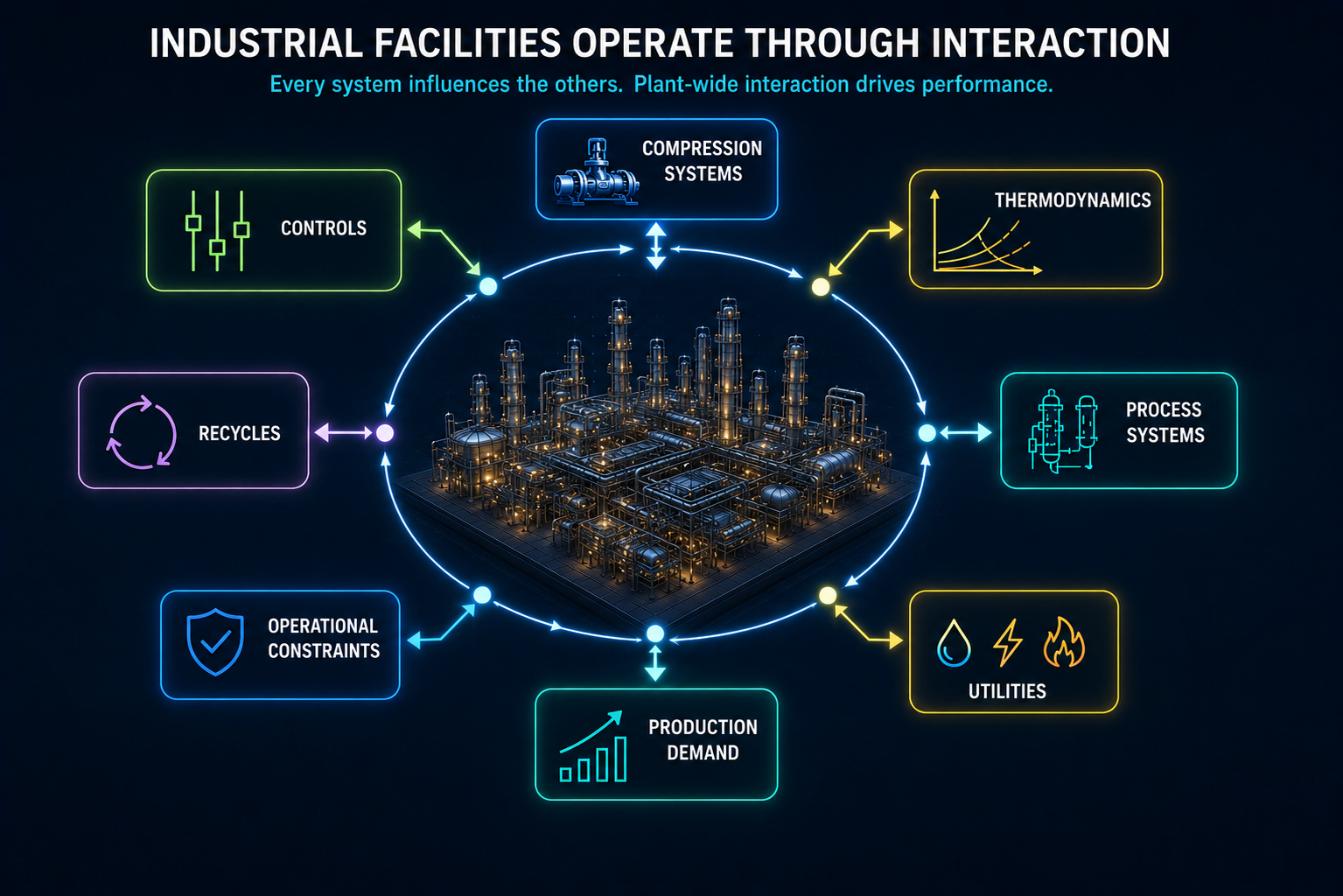
A performance change may involve equipment response, process conditions, control action, recycle behaviour and production demand at the same time. The plant does not separate these interactions according to the applications used to observe or calculate them.
Monitoring may identify a change without calculating the engineering interactions driving it. A simulation may provide detailed analysis while remaining detached from current operation. An OEM application may understand the machinery but not its full process and production context.
Each system can be correct within its own scope while the wider cause, consequence and facility response remain distributed across several technologies.
Plant behaviour extends beyond the boundary of any individual application.
Plant Context Must Be Maintained During Execution
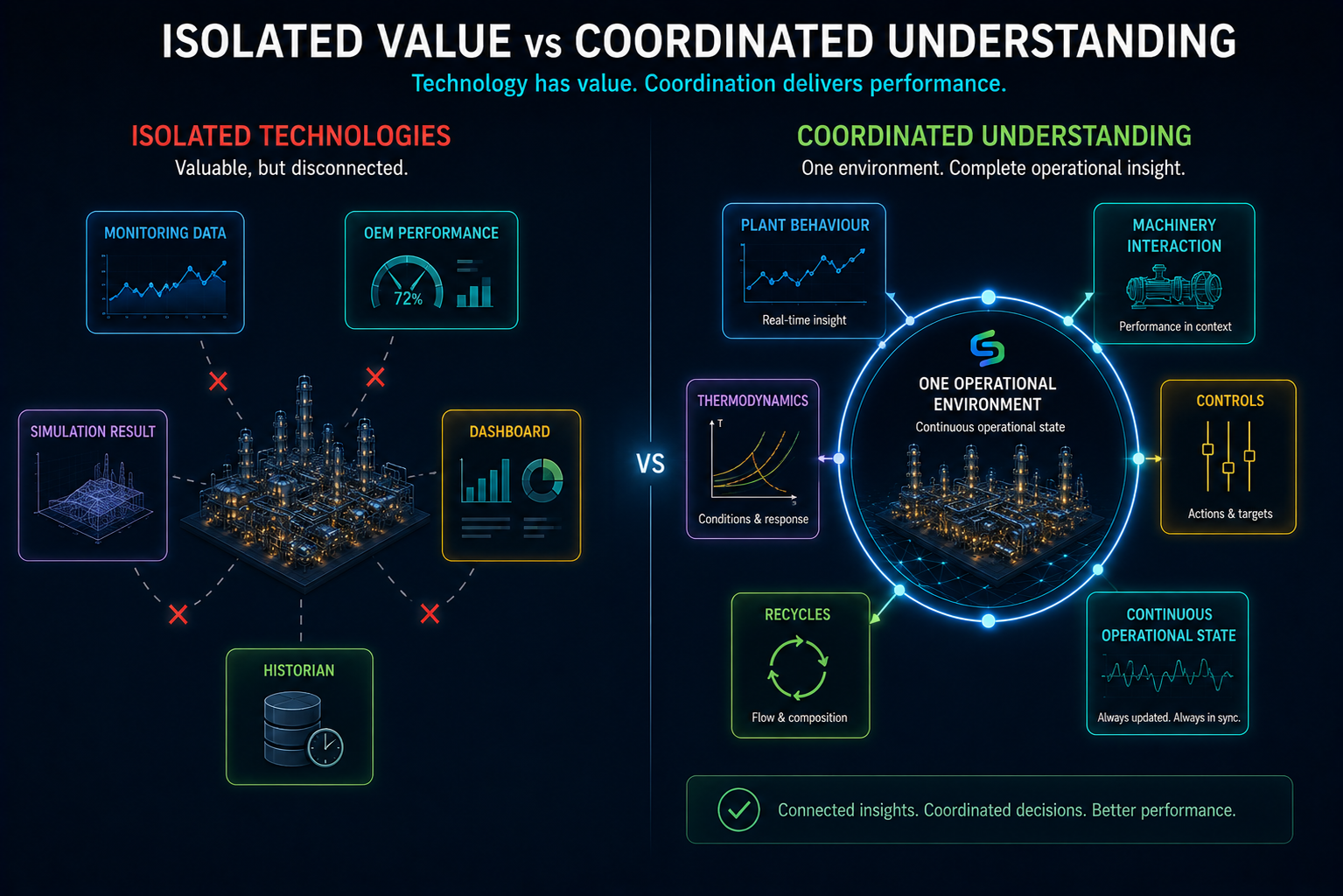
Interfaces can exchange measurements, calculated values and results between applications. They do not maintain the engineering relationships that produced those results or determine how a change propagates through connected equipment, controls and recycles.
A continuously executing engineering system maintains the facility representation, calculated state and interacting behaviour as conditions change. Monitoring, simulation and specialist applications can then work with a consistent plant context rather than reconstructing it independently.
Integration remains essential for extending this capability across plant data, customer infrastructure and specialist technologies without making interfaces responsible for the core engineering execution.
Plant behaviour requires coordinated systems.
An Engineering Foundation Built Around the Plant
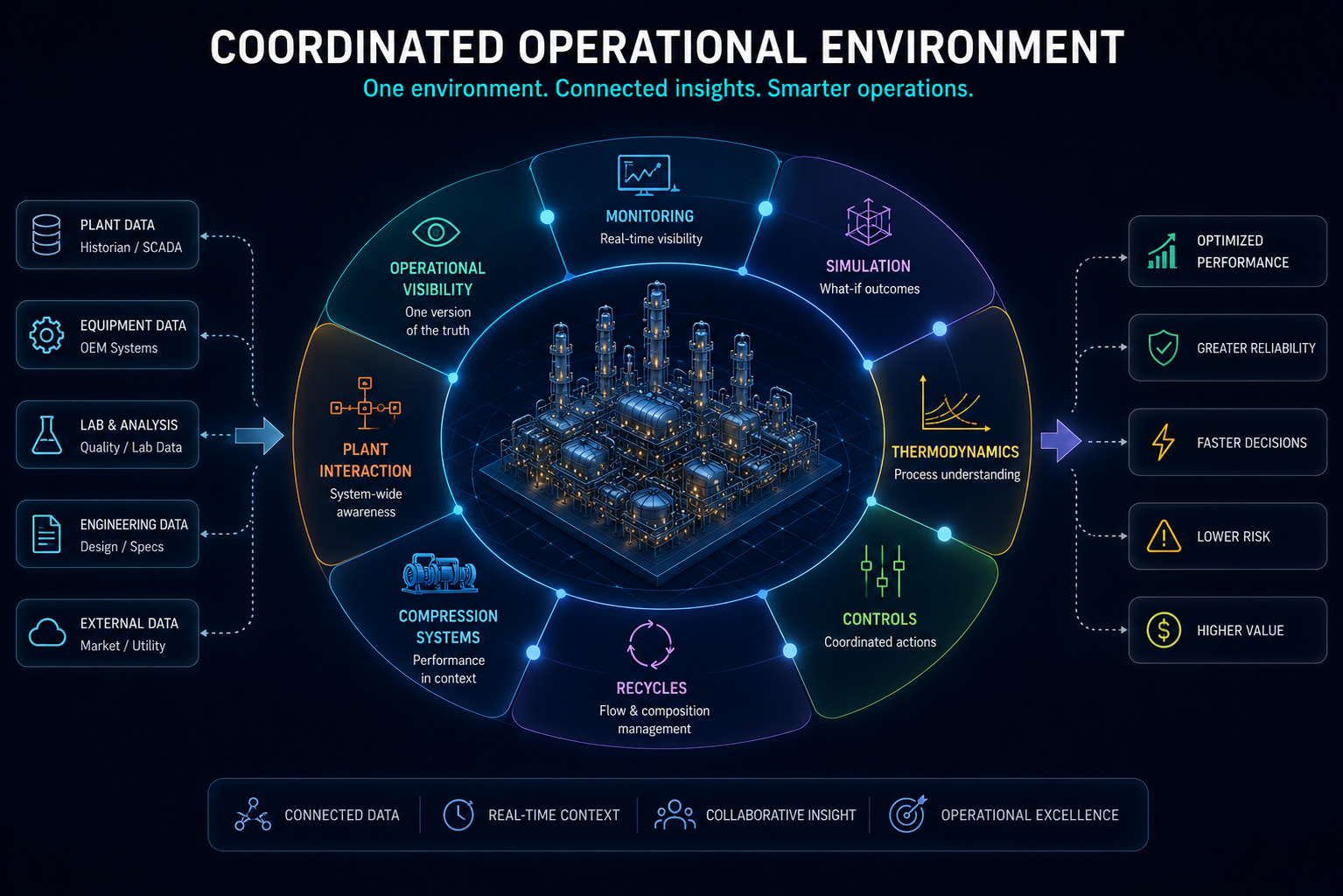
Simulytica develops the core technologies required for plant engineering and operation within one architecture. Thermodynamics, plant execution, intelligent solving, maintained state, simulation and monitoring operate together around an operations-driven, plant-first representation.
Customer data, OEM technology and specialist applications integrate with this engineering foundation where required. The core system remains scalable, continuously executing and directly accessible for operational applications, engineering investigation and viable digital twins.
One engineering architecture built around the operating plant.